
Free printable chore charts for kids and teens
These free printable chore charts are four A4 weekly PDFs for kids aged 4 to 6 (with pictures), 7 to 9, 10 to 12 and teens 13 to 17. Print one, write your child's name, stick it on the fridge and tick each chore as it gets done, Monday to Sunday. No sign up, no email.
A4 PDF, no email needed.


Which chore chart suits my child's age?
Every chart uses the chores from our chores by age guide.
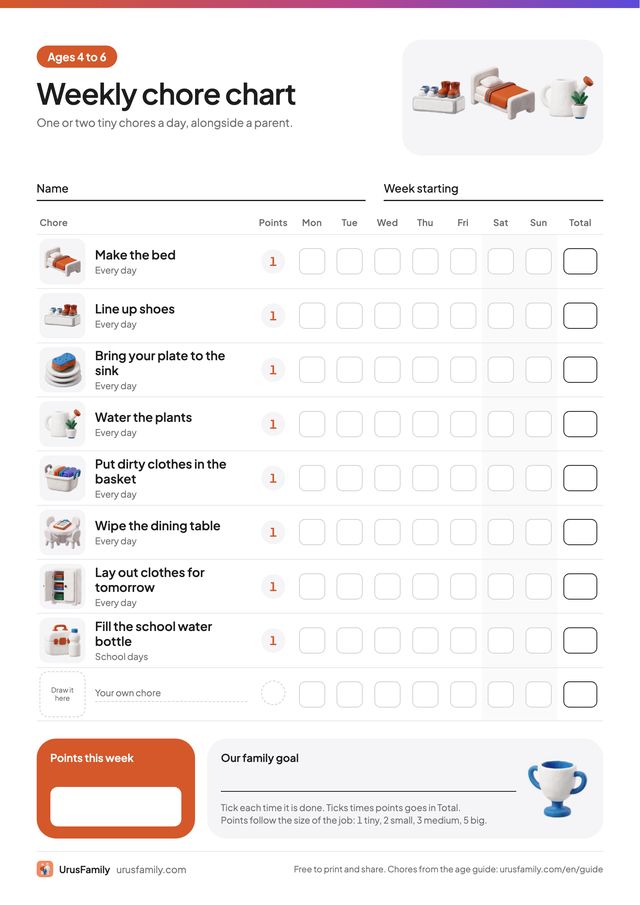
With pictures, for non-readers
- Eight chores, each with a picture
- One or two tiny chores a day
- A blank box to draw their own chore
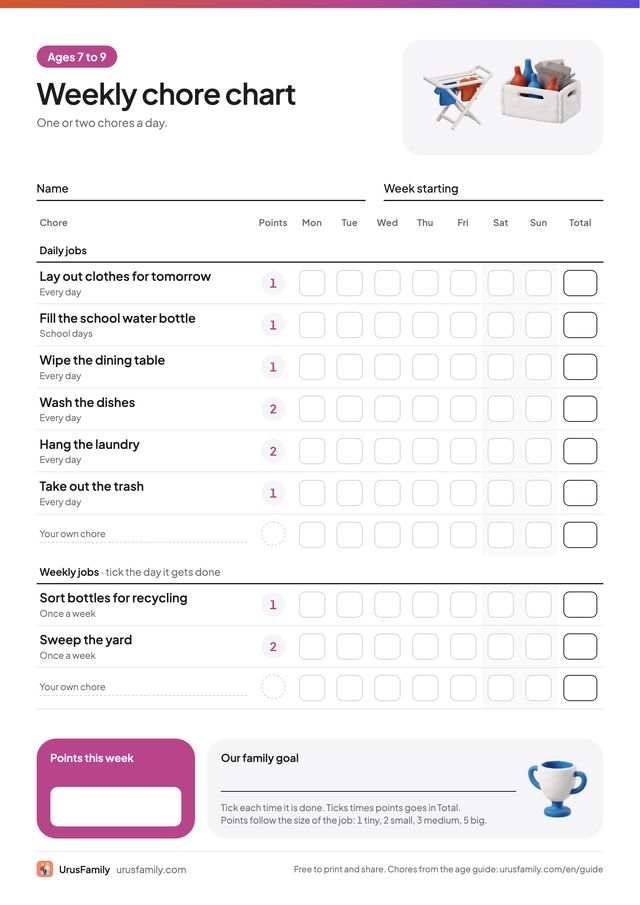
Daily and weekly chores
- Wash the dishes, hang the laundry, take out the trash
- One or two chores a day
- Two blank rows for their own chores
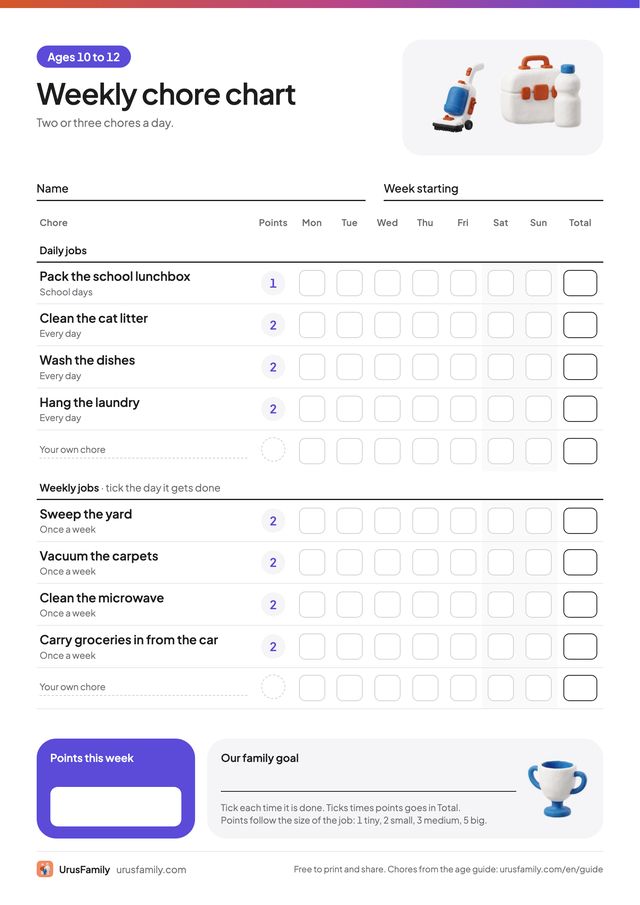
More responsibility
- School lunchbox, cat litter, vacuuming
- Two or three chores a day
- 1 or 2 points by the size of the job
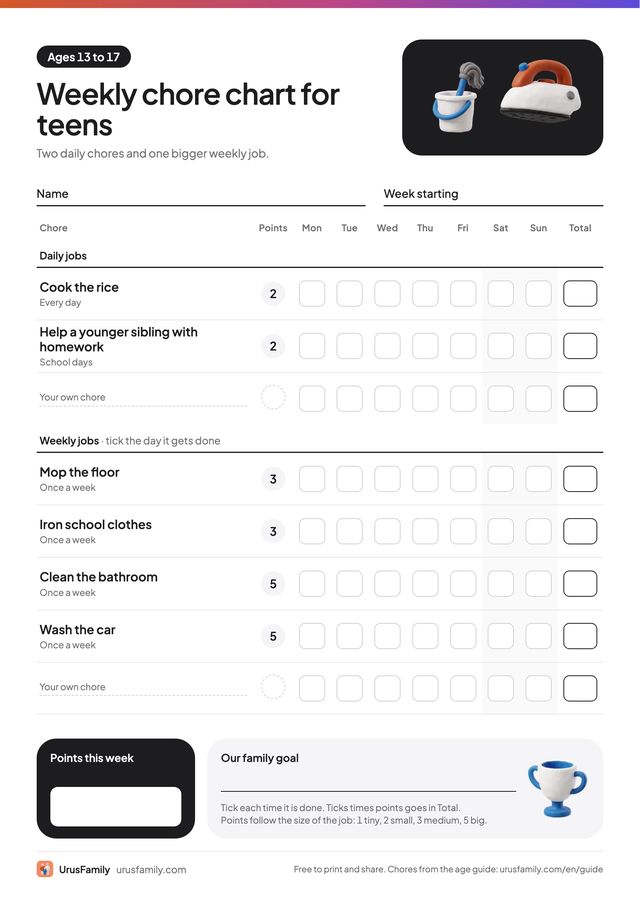
A grown-up chart for teens
- Cook the rice, mop the floor, wash the car
- Two daily chores, one bigger weekly job
- Big jobs worth up to 5 points
What is on every chart?
One A4 sheet per child per week. Everything on one side.
- Name and weekYour child writes their own name. Ownership starts there.
- A Monday to Sunday gridOne box a day for every chore, big enough for small hands.
- A points columnPoints follow the size of the job: 1, 2, 3 or 5, the same as in the app.
- Points this weekTicks times points, then write the total in the big box.
- Our family goalOne shared goal, so siblings work together instead of racing.
Why points by size? Read the family points system.
How do you use a chore chart so it lasts?
The chart that works is not the prettiest one. It is the one that gets ticked every day.

Circle two or three chores. Kids who pick their own rarely argue the next day.

On the fridge or the bedroom door, not where only the adults see it.
After school or before dinner. Let your child do the ticking.

Ticks times points, celebrate the total, and print a fresh sheet for next week.


Not sure which chores fit? The chores by age guide explains how many chores suit each age.
When should you move from a paper chart to an app?
A paper chart is enough for many families. Move only when the paper starts adding work for you.
Paper is enough when
- One or two kids, with the same routine every week
- An adult at home checks it every day
- No allowance is tied to the chores
An app helps when
- Several kids, and adding up points takes real time
- Parents work shifts, so the fridge chart is rarely seen
- Allowance is tied to points and has to be exact
- Routines change with the season, like Ramadan or school holidays
There is an honest comparison of a paper chart, WhatsApp or an app. To cut the reminders, read chores without nagging. UrusFamily is free during the launch period, then RM 9.90 a month or RM 79 a year for the whole family.


Free for iPhone and Android.

Questions about printable chore charts
Are these chore charts really free?
Yes. Download them directly with no email or sign up, and print as many as your family needs. Every chart is an A4 PDF.
Which chart suits a child who cannot read yet?
The ages 4 to 6 chart. Every chore has a picture, so your child can recognise it without reading, and there is a blank box to draw their own chore.
How do the points on the chart work?
Each chore has points by the size of the job: 1 for tiny, 2 for small, 3 for medium and 5 for big. Multiply the ticks by the points and write the result in the Total column.
Do I print a new chart every week?
Yes, one sheet per child per week. Many families print four at once for the month and keep the old sheets to see how their child has grown.
Can I change the chores on the chart?
Yes. Every chart has blank rows for your own chores. If the list feels too easy, try the next age up or check the chores by age guide.
How is a paper chart different from the UrusFamily app?
A paper chart is ticked with a pen and added up by hand. In UrusFamily, kids tick chores from their own profile, points add up automatically, and every point goes toward one family goal.