
A school holiday routine, four calm weeks
A good school holiday routine for kids needs only three fixed things each day: the same bedtime and wake-up time, one block of chores your child owns, and screen time after chores are done. In Malaysia the 2026 year-end break starts on 4 December (Group A) or 5 December (Group B), and school opens on 4 January 2027.
With free PDF charts.

When are the 2026 year-end school holidays and when does school open?
Dates by state group from the KPM Academic Calendar. Group A starts a day earlier.
| Group | States | Last school day | Year-end break 2026 | 2027 session starts |
|---|---|---|---|---|
| Group A | Kedah, Kelantan, Terengganu | Thursday, 3 December 2026 | 4 to 31 December 2026, 28 days | Monday, 4 January 2027 |
| Group B | Johor, Melaka, Negeri Sembilan, Pahang, Perak, Perlis, Pulau Pinang, Sabah, Sarawak, Selangor, WP Kuala Lumpur, Labuan and Putrajaya | Friday, 4 December 2026 | 5 to 31 December 2026, 27 days | Monday, 4 January 2027 |
When are the 2027 school holidays?
| Break | Group A | Group B |
|---|---|---|
| Term 1 break | 5 to 13 March 2027 | 6 to 14 March 2027 |
| Mid-year break | 21 May to 5 June 2027 | 22 May to 6 June 2027 |
| Term 2 break | 27 August to 4 September 2027 | 28 August to 5 September 2027 |
| Year-end break | 3 to 31 December 2027 | 4 to 31 December 2027 |
Sources: Kalendar Akademik 2026, KPM (Appendix A and B), Kalendar Akademik 2027, KPM and Berita RTM, 3 October 2026. Checked on 31 October 2026. KPM also gives extra festival days that differ by group; check your school's circular.
How do you split the year-end break into four weeks?
The year-end break is almost exactly four weeks. Give each week one purpose, not a long list.
Keep the first two or three days easy. Then sort old books and stationery, wash the school bag and shoes, and set a holiday wake-up time.
Agree on one daily chore and one area for the whole break, such as the dining table or the shoe rack. Add one small project, such as wiping the fans and switches.
The routine can loosen, but keep bedtime and one small chore a day, even at the grandparents' house. Christmas falls on 25 December.
Move bedtime earlier a little at a time, check uniforms and books, and practise the morning routine. Full list in the back to school routine.


Week 1 starts on 4 December for Group A and 5 December for Group B. Week 4 covers 1 to 3 January, before school opens on the Monday.
What does a daily routine look like during the school holidays?
One example holiday day for a primary school child. It is an example, not a rule; adjust it to your family.
- 8.00 amWake up, make the bed, showerStay close to the school-day wake-up time, so week four is easier.
- 8.30 amBreakfast, then the chore blockYour child's daily chores come first, before any screen.
- 10.00 amPlay, read or your own projectScreen-free time: cycling, drawing, building blocks, library books.
- 12.30 pmHelp cook lunchWash the vegetables, set the plates, then clear the table.
- 2.00 pmQuiet restA short nap, a book or an audio story, especially on hot days.
- 4.00 pmScreen timeAfter chores are done, within the screen time limits by age.
- 5.30 pmGo out or play outsideThe park, the field or a walk together before maghrib.
- 8.00 pmDinner and a tidy-up togetherFive minutes of the whole house tidying, then family time.
- 9.30 pmBedtimeChildren aged 6 to 12 need 9 to 12 hours of sleep a day.
Routine by age
| Age | Sleep a day | Chores a day | Ideas for own time |
|---|---|---|---|
| 4 to 6 | 10 to 13 hours including naps (3 to 5 years); 9 to 12 hours (6 years) | One small chore, with a parent | Free play, drawing, a picture routine chart |
| 7 to 9 | 9 to 12 hours | One to two chores | Reading alone, cycling, crafts |
| 10 to 12 | 9 to 12 hours | Two to three chores | A project of their choice, learning an easy recipe |
| 13 to 17 | 8 to 10 hours | Two daily chores and one bigger weekly job | Cook one meal a week, hobbies, sport |
Sleep hours: CDC, About Sleep, based on the American Academy of Sleep Medicine consensus statement (2016), checked 31 October 2026. Number of chores: our chores by age guide.
Which chores can kids own during the school holidays?
Owning a chore means one area belongs to your child for the whole break, instead of being told every day. All examples come from our age guides.
Ages 4 to 6
Area: toys and the shoe rack
- Tidy toys before dinner
- Line up shoes on the rack
- Water the plants
- Take plates to the sink

Ages 7 to 9
Area: the dining table
- Wipe the table after meals
- Hang the laundry
- Sort bottles for recycling
- Sort out books and stationery

Ages 10 to 12
Area: the living room
- Vacuum the carpet
- Help cook lunch
- Clean the cat litter
- Carry groceries in from the car

Ages 13 to 17
Area: one bathroom or the kitchen
- Mop the floor
- Clean the bathroom
- Cook the rice
- Wipe the fans and switches


How do you balance screen time during the holidays?
The holidays are when screen time spills over most easily. Four simple house rules help.
- Screens after choresDaily chores and outdoor play first, screens later. Kids know the order without asking.
- Same limits as school daysThe holidays do not change the limits. See screen time by age from WHO, KKM and AAP.
- No screens in the bedroomOne charging spot in the living room. It protects the sleep that needs to be back to normal by week four.
- Plan it together on day oneSit down and agree on when, where and what. An agreement holds better than a ban.
How do you link holiday chores to points or an allowance?
A long break suits one family goal that everyone fills together.
Points for one holiday goal
Every finished chore earns points, and all points fill one shared goal, such as a beach picnic or a meal out in the last week. Bigger jobs like wiping the fans earn more than small ones. The full method is in the family points system.

Allowance: a fixed base, a small part for effort
Basic chores are not paid because they are part of family life. A bigger holiday project can go into the effort part of an allowance. See the kids' allowance guide and try the allowance calculator for amounts in RM.
Which charts can I print for the school holidays?
Four free weekly chore charts, one for each age band. Print one for every week of the break.
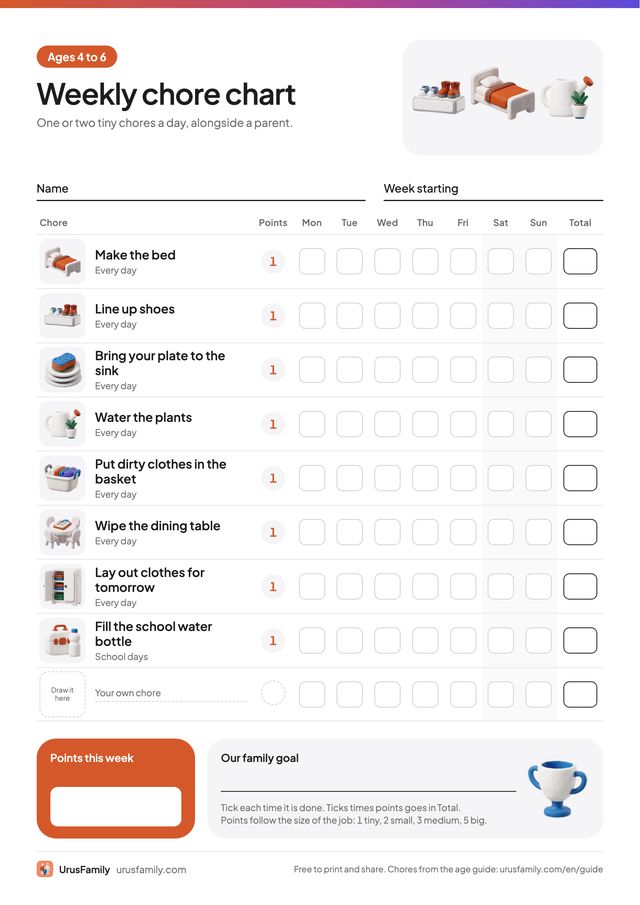
With pictures, for pre-readers
- Eight chores, each with a picture
- An empty box for your child to draw their own
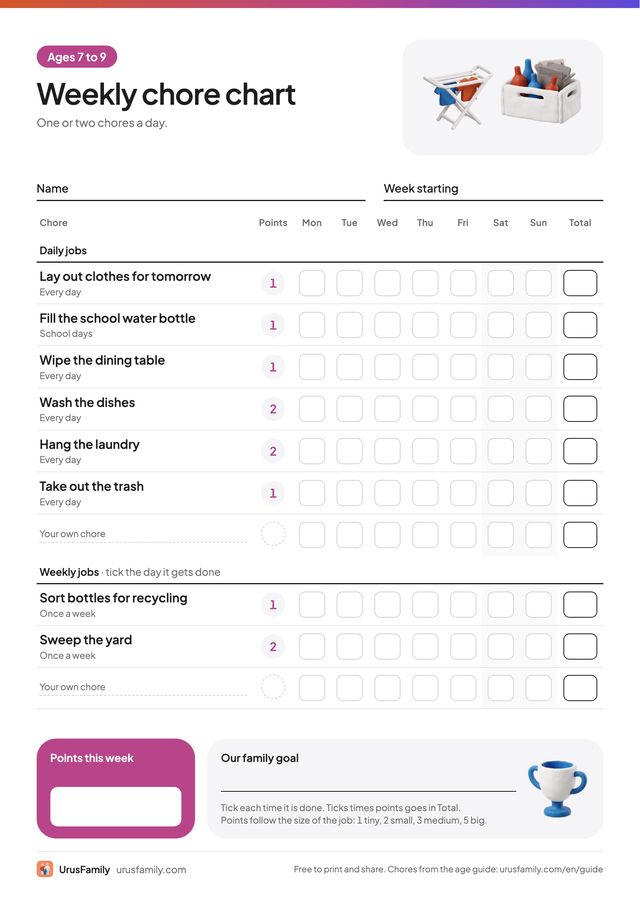
Daily and weekly chores
- Wash dishes, hang laundry, take out the trash
- Two empty rows for your own chores
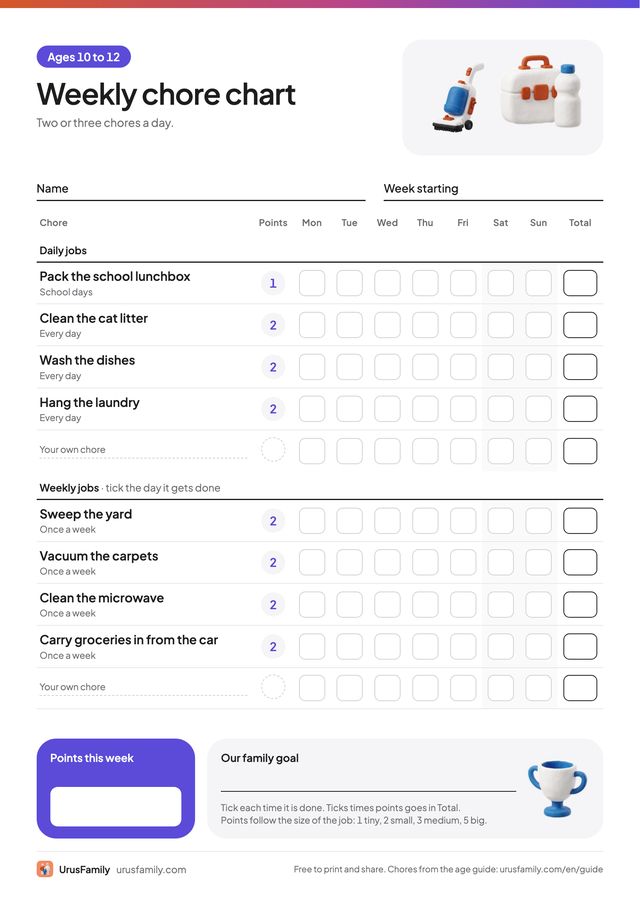
More responsibility
- Cat litter, vacuuming
- 1 or 2 points by chore size
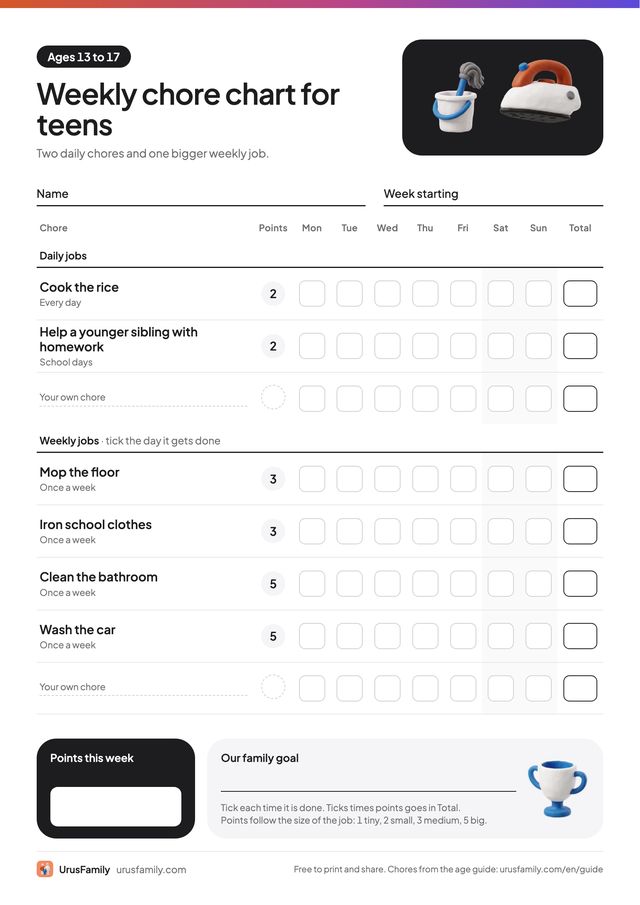
A more grown-up teen chart
- Cook rice, mop floors, wash the car
- Big jobs worth up to 5 points


Under 6 and not reading yet: try the toddler routine charts with pictures for morning, bedtime and the full day. All charts are free, with no email.
Can UrusFamily organise the school holidays for me?
Paper charts are enough for many families. If you want it all on your phone, UrusFamily has a School holidays season pack that adds suggested chores such as sorting books and stationery, washing the school bag and shoes, helping cook lunch, and wiping the fans and switches.
Each child ticks chores from their own profile, points fill the family goal, and the family calendar keeps trip and balik kampung dates where everyone can see them.


Free on iPhone and Android.

Questions about a school holiday routine
When are the 2026 year-end school holidays in Malaysia?
According to the KPM Academic Calendar 2026, Group A (Kedah, Kelantan and Terengganu) is on holiday from 4 to 31 December 2026, and Group B (all other states and the Federal Territories) from 5 to 31 December 2026. The 2027 session starts on 4 January 2027 for both groups.
Do kids need a strict schedule during the holidays?
No. Three fixed things are enough: bedtime and wake-up time, one block of chores, and screen time after chores are done. Everything else can stay flexible, especially during trips and balik kampung.
How many chores should kids do during the school holidays?
As a starting point: one small chore a day for ages 4 to 6, one to two for 7 to 9, two to three for 10 to 12, and two daily chores plus one bigger weekly job for 13 to 17. The holidays are a good time to teach one new chore.
What if both parents work during the school holidays?
Put the chores and screen time on a chart on the fridge or in an app, so kids know what to do without being asked. A carer or the grandparents can follow the same chart, and you check it together in the evening.
Should kids be paid for holiday chores?
Basic chores are part of being in the family. If you give an allowance, a simple approach is a fixed base amount plus a small part that moves with effort, such as a bigger holiday project. UrusFamily only records the allowance; parents pay in cash or by transfer.
When should we start getting ready for school?
Start in the last week of the holidays. Move bedtime earlier a little at a time, check uniforms, shoes and books, and put the key school dates in the family calendar. The full checklist is on the back to school routine page.