
Toddler routine charts with pictures, free to print
These free toddler routine charts are three A4 PDFs for children aged 2 to 6 who cannot read yet: a morning routine, a bedtime routine and a full day chart. Every step is a picture, such as wake up, brush teeth, bath and sleep, with a circle to tick each day. No sign up or email.
A4 PDF, no email.


Why do picture routines help children who cannot read yet?
Young children cannot read a list, but they can read pictures. Here is what two sources we checked say.
- Pictures show what is expectedChildren often do not follow a request because they do not understand what to do. A picture stays in view, unlike spoken words. (NCPMI)
- Your child can see when they are done and what comes nextA picture schedule has a clear beginning, middle and end, so children can see their own progress. (NCPMI)
- Fewer battles and fewer "no"sWhen a child can predict the next step, parents need to correct far less often. (NCPMI)
- Predictable routines help children feel safeChildren feel safe when they know what to expect. Keep routines for young children short, because their attention spans are short. (CDC)
Sources: NCPMI, How to Use Visual Schedules to Help Your Child Understand Expectations (Backpack Connection Series, updated 2018) and CDC, Tips for Relying on Routines and Rules. Both checked on 28 October 2026 and summarised in our own words.
Which routine chart should I print first?
Start with the hardest time of day. Once it runs smoothly, add the next one.
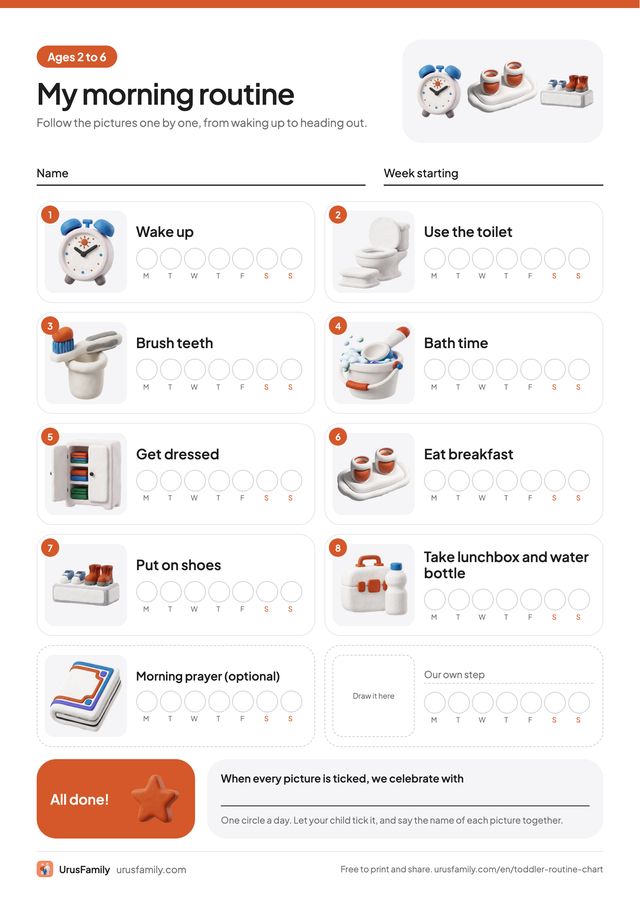
Morning routine, before nursery or kindergarten
- Wake up, toilet, brush teeth, bath, get dressed
- Breakfast, shoes, lunchbox and water bottle
- A morning prayer tile, marked optional
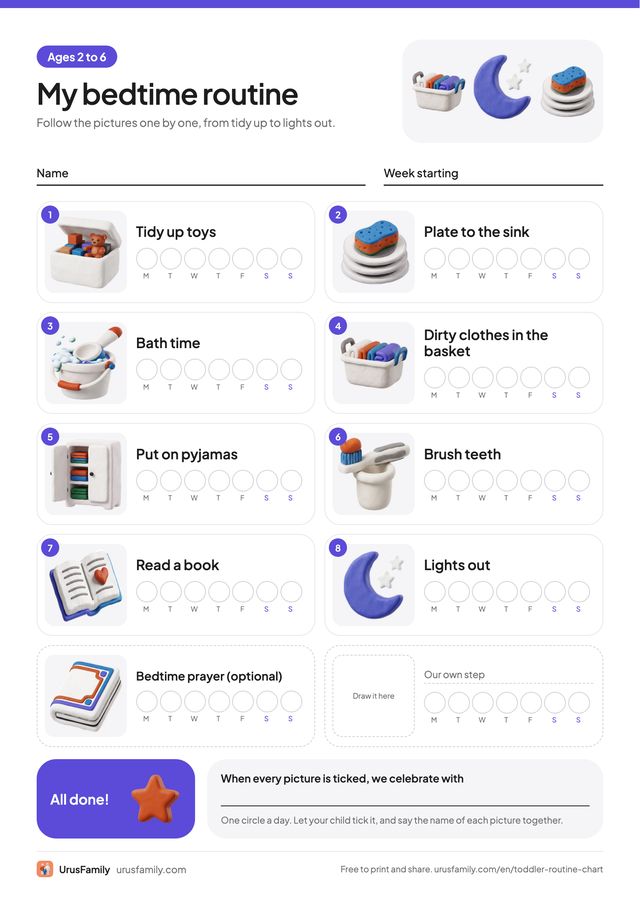
Bedtime routine, from tidy up to lights out
- Tidy toys, plate to the sink, bath
- Pyjamas, brush teeth, read a book, sleep
- A bedtime prayer tile, marked optional
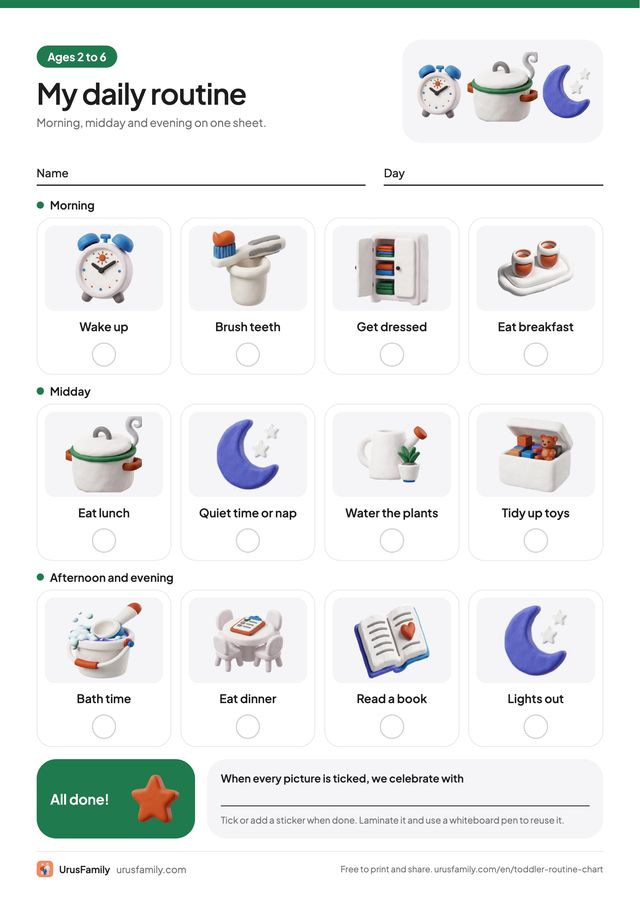
A whole day on one sheet
- Twelve pictures: morning, midday, evening
- Quiet time or nap, water the plants
- Laminate it and reuse it every day
How do you introduce a routine chart in week one?
Following a schedule is a skill children learn. Week one is for learning it together.
Mornings before nursery or bedtime, whichever has the most drama. Print that one chart first.

Let your child draw their own step in the "Draw it here" tile and write their name. Put it up at their eye level.
Point to the next picture and say its name. Let your child tick the circle after each step.

Celebrate "All done!" with a hug or an extra story. Once it is smooth, try the daily chart.


These steps follow the NCPMI tips: start with a hard time of day, involve your child in making the schedule, let them mark it done, and refer to it often.
Which steps are on each chart?
Everyday steps for a Malaysian home. Cross out any that do not fit your family.
| Chart | Steps | Pictures your child draws |
|---|---|---|
| Morning routine | Wake up, use the toilet, brush teeth, bath time, get dressed, eat breakfast, put on shoes, take lunchbox and water bottle, morning prayer (optional), your own step | Toilet, brush teeth, bath, prayer |
| Bedtime routine | Tidy up toys, plate to the sink, bath time, dirty clothes in the basket, put on pyjamas, brush teeth, read a book, lights out, bedtime prayer (optional), your own step | Tidy toys, bath, brush teeth, read a book, prayer |
| Daily routine | Morning: wake up, brush teeth, get dressed, breakfast. Midday: lunch, quiet time or nap, water the plants, tidy toys. Evening: bath, dinner, read a book, lights out | Brush teeth, tidy toys, bath, read a book |
The prayer tile has a dashed border and is marked optional. Families who do not practise it can cross it out or write another step. Many Malaysian families bathe both morning and evening, so bath time is on both charts; drop the one you do not need.
What comes next when your child is older?
Once self-care routines run smoothly, children from age 4 can start small jobs around the house. Our free printable chore charts include a picture chart for ages 4 to 6 and charts for ages 7 to 17.
If routines change with morning or afternoon school sessions, or you have several children, UrusFamily keeps repeating tasks for each child and children tick them from their own profile. The paper charts work fine without the app.


Free for iPhone and Android.

Questions about toddler routine charts
Are these routine charts really free?
Yes. Download them directly with no email or sign up, and print as many as you need. All three charts are A4 PDFs, in English and Bahasa Melayu.
What age are they for?
They are made for ages 2 to 6, children who cannot read yet. For a two year old, start with three or four pictures and fold or cover the rest.
What is the "Draw it here" tile for?
Each weekly chart has one blank tile for a step of your own, like watering the plants or salam with parents. Let your child draw it. The NCPMI handout suggests involving children in making the schedule, including drawing the pictures.
Is the prayer step required?
No. It has a dashed border and is marked optional. Cross it out or write another step there if your family does not practise it.
How long until my child follows it alone?
Every child is different. Following a schedule is a learned skill, so look at the chart together at the same time each day and let your child tick it. Keep one chart until it runs smoothly before adding another.
How is a routine chart different from a chore chart?
A routine chart is self-care steps in order, such as brushing teeth and getting dressed. A chore chart is for household jobs with points, for ages 4 to 17, on our printable chore charts page.